How to Scale Mobile App Installs: A Performance Marketer's Guide
Share Article

How to Scale Mobile App Installs: A Performance Marketer's Guide
Scaling mobile app installs requires a strategic approach to publisher networks, performance metrics, and campaign optimization. This guide covers the mechanisms, tools, and tactics that performance marketers use to drive measurable growth across multiple channels and geographies.
What does "scaling mobile app installs" mean? It refers to the process of systematically increasing the volume of app downloads while maintaining or improving unit economics, typically measured through CPI (cost per install), CPA (cost per action), or CPE (cost per engagement) campaigns. Scaling is not about chasing volume blindly. It's about expanding reach, optimizing spend allocation, and leveraging networks that connect you to verified, high-quality publishers.
The Core Challenge: Volume vs. Quality
The tension between volume and quality defines every scaling decision. You can drive thousands of installs from low-quality sources, but if those users don't retain, monetize, or engage, you've wasted spend.
Quality publishers operate differently. They have curated audiences, genuine engagement, and transparent conversion tracking. The difference between a publisher network with 50 partners and one with 350+ partners is access to diverse, quality inventory across verticals. Klink Labs operates a network of 350+ publishers reaching 5,000,000+ users worldwide, which creates direct access to high-intent audiences rather than remnant inventory.
Verification matters more than impressions. When you pay only for verified actions, not clicks or impressions, your entire cost structure shifts. You eliminate waste at the source.
Multi-Channel Distribution: The Scaling Foundation
Successful scaling relies on multiple, independent channels feeding your app. No single source should represent more than 30-40% of your volume. This reduces dependency and protects against algorithm changes, policy shifts, or publisher issues.
Publisher Networks. These connect advertisers directly to curated publishers. Unlike ad exchanges or DSPs that prioritize reach, publisher networks often emphasize quality and transparency. Klink Labs, for example, maintains live access to 10,000+ offers across gaming, fintech, and lifestyle verticals, with 2,000+ active offers running at any given time. This depth matters for scaling because it creates redundancy and flexibility.
In-App Offerwall Placements. Offerwalls work well for fintech and crypto apps because existing users earn rewards by completing offers. This creates a natural, incentivized acquisition loop. Your app installs become a monetization channel for other apps, and vice versa.
Direct Publisher Relationships. For high-volume campaigns, direct partnerships with top-performing publishers often yield better rates and priority inventory allocation than network-level campaigns.
Geography-Specific Networks. Klink Labs operates across 140+ countries with focus in the US and EU. Regional networks often have stronger relationships and better optimization for local audiences than global platforms attempting to serve all markets equally.
Campaign Structure: CPI, CPA, and CPE Models
Your campaign model directly impacts scalability and risk allocation.
CPI (Cost Per Install). You pay for installs only. Simple, predictable, and transparent. CPI works well when your primary goal is user acquisition at scale. The risk sits with the publisher: they must deliver genuine installs or don't get paid.
CPA (Cost Per Action). You pay for a post-install action: a purchase, account creation, deposit, or gameplay milestone. CPA campaigns scale more slowly than CPI but generate higher-quality users because payment ties to actual user behavior, not just the install event.
CPE (Cost Per Engagement). You pay for engagement signals: opens, level completions, or feature usage. This sits between CPI and CPA in terms of cost and user quality.
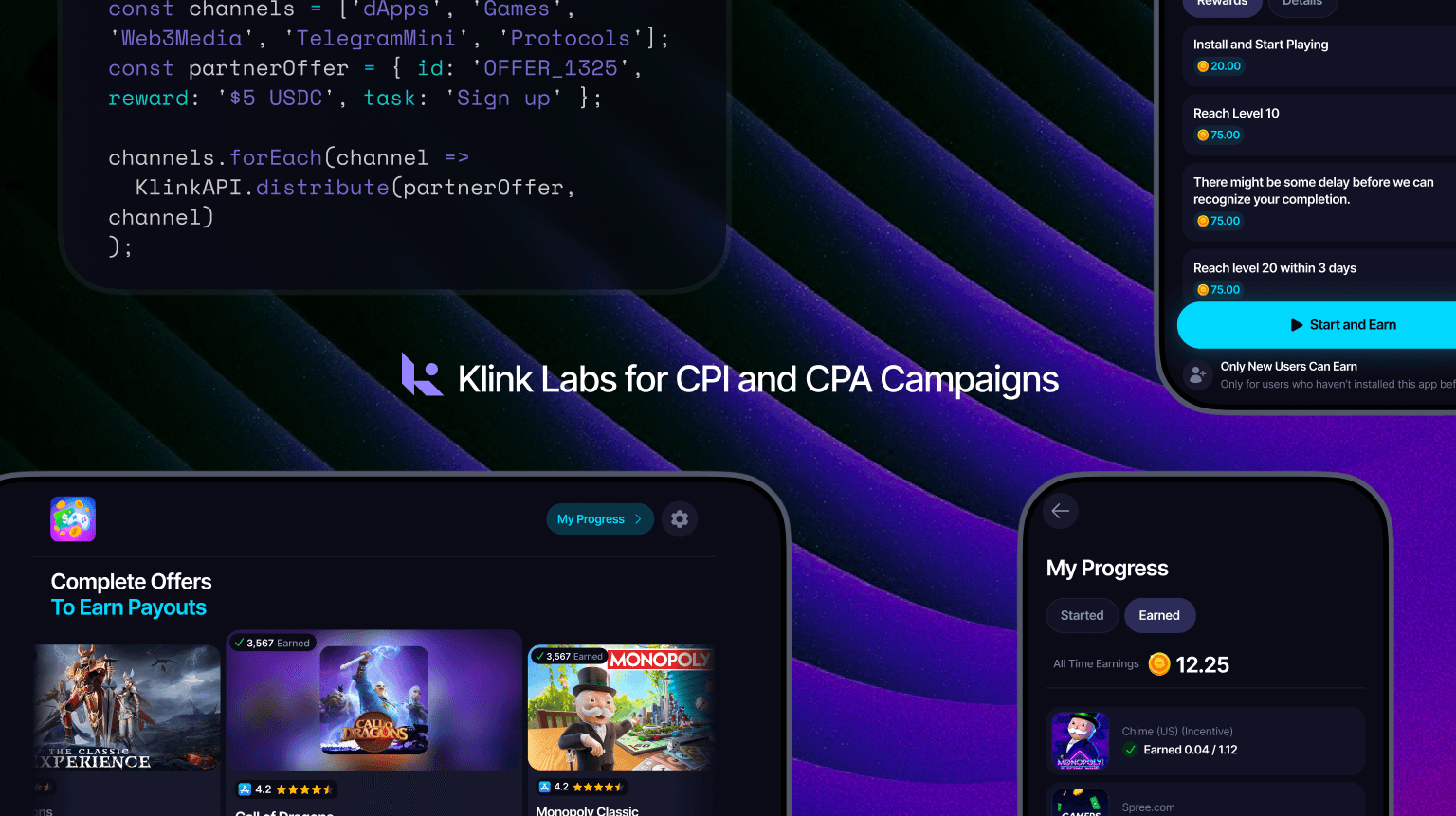
Most performance marketers use a blend of these models. You might run CPI campaigns for volume growth while simultaneously running CPA or CPE campaigns to optimize for users who actually generate value. Klink Labs supports all three campaign types through the same network, allowing you to test different models without switching platforms.
Speed and Integration: Reducing Time to Volume
Campaigns that launch in weeks, not hours, lose momentum and market opportunity. Modern networks should support rapid deployment.
Klink Labs launches campaigns in hours through either iFrame or API integration. This matters operationally because you're not waiting for approval cycles, creative production, or technical setup. You can test new publishers, new geographies, or new verticals without internal overhead.
Real-time reporting dashboards are non-negotiable. You need visibility into installs, conversions, and cost metrics as they happen, not in daily summaries. This enables rapid optimization: if a publisher is underperforming, you adjust or pause the campaign within the same day.
Optimization Tactics for Scale
Once campaigns are live, scaling depends on continuous optimization.
Cohort Analysis. Track user quality by source, publisher, and geography. Don't treat all installs equally. A user acquired from Publisher A in the US may have 3x the LTV of a user from Publisher B in Southeast Asia. Allocate more budget toward higher-LTV cohorts.
Creative Testing. Your app store listing, screenshots, and preview video drive conversion rates on publisher offerwalls. A 10% improvement in conversion rate directly improves your effective CPI by 10%. Test variations systematically.
Publisher-Level Performance. Most publisher networks offer dashboard visibility into individual publisher performance. Identify your top 20% of publishers by volume and efficiency. Increase budget to them, and allocate freed budget to testing new publishers at the margin.
Vertical and Category Alignment. Gaming apps scale best on gaming-focused publishers. Fintech apps perform well on crypto and trading communities. Klink Labs' 350+ publisher network spans gaming, fintech, and lifestyle verticals, allowing you to concentrate spend where audiences naturally exist.
Geo Optimization. Rates and user quality vary significantly by country. US and EU audiences often have higher LTV than emerging markets, but also higher acquisition costs. Test your app across multiple geographies to identify your most profitable markets, then scale there first.
Real-World Evidence: The Wirex Case
Theoretical frameworks matter less than results. Klink Labs' Wirex case study demonstrates practical scaling impact.
Wirex, a cryptocurrency platform, used Klink Labs to expand user acquisition. The campaign delivered 207% growth in users and 68% revenue increase. This wasn't achieved through a single channel or campaign model. It required testing multiple publisher relationships, optimizing creative, and refining targeting based on user cohort data.
The Roxonn presale campaign overdelivered on its presale target by 52.7%, another indicator that publisher network scale, when paired with optimization, generates measurable business outcomes.
Avoiding Common Scaling Mistakes
Many performance marketers plateau because they repeat the same errors.
Overspending on Underperforming Channels. If a publisher isn't converting, pause it quickly and reinvest elsewhere. Scaling means eliminating leaks, not adding more water to a broken bucket.
Ignoring User Quality Metrics. Volume without retention, engagement, or monetization is vanity. Track cohort LTV, day-30 retention, and in-app purchase rates by source. Scale only the sources that drive real business metrics.
Neglecting New Geography Testing. Your most profitable market today may be saturated in six months. Dedicate 10-15% of budget to testing new geographies and publishers. This creates a pipeline for future growth.
Setting Campaign Parameters Too Tight. Overly specific targeting reduces publisher inventory and slows volume. Test broader audience definitions and let publishers optimize within those bounds.
Relying on Single-Network Growth. Publisher networks compete. Using multiple networks reduces dependency and provides negotiating leverage. Klink Labs competes in the same space as platforms like Tapjoy, AdGate Media, and Adscend Media. The key differentiator is network composition: 350+ publishers, 10,000+ live offers, and verified action-based pricing create redundancy and flexibility that monolithic platforms can struggle to match.
Technical Considerations for Scaling
Integration method affects your ability to scale operationally.
iFrame integration works for most apps: the advertiser displays the Klink Labs offerwall within the app, users complete offers, and installs flow directly. API integration offers deeper control and data flow, allowing custom integration with your backend systems.
Real-time reporting means you're not blind to performance. A dashboard that updates every 24 hours is inadequate when scaling. You need hourly or real-time visibility to make optimization decisions at volume.
Scaling Across 140+ Countries
Geographic expansion is a natural scaling path once your core market is established. The US and EU represent proven demand, but other markets offer lower acquisition costs and newer user bases.
Operating in 140+ countries requires handling currency conversion, local payment methods, regulatory compliance, and regional publisher networks. Klink Labs' global footprint means you can scale to new countries without building new publisher relationships from scratch.
Getting Started: Your Action Plan
Map your current acquisition channels and identify gaps where publisher networks could add volume.
Define your target user profile by LTV. Calculate how much you can spend per install while maintaining acceptable payback periods.
Start with CPI campaigns to establish baseline volume and publisher performance.
Implement cohort tracking to identify your highest-quality user sources.
Gradually shift budget toward CPA or CPE campaigns with top-performing publishers to optimize for user quality.
Test new geographies and verticals with 10-15% of budget while scaling proven channels.
Klink Labs enables all of these steps through a single network: 350+ publishers, multiple campaign models, real-time reporting, and hour-based campaign launches. For publishers looking to monetize their traffic, Klink Labs operates as a monetization platform connecting you to advertisers running these campaigns.
Frequently Asked Questions
1. Q: What CPI rates should I expect when scaling mobile app installs?
A: Rates vary by vertical, geography, and campaign structure. Gaming apps in the US operate on different economics than fintech apps in Southeast Asia. Contact Klink Labs directly at klinklabs.com for a tailored quote based on your app category and target markets.
2. Q: How many publishers should I be working with to scale effectively?
A: Start with 10-15 established publishers and gradually expand to 30-50+ as you prove unit economics. Diversification protects against dependency, but managing too many publishers becomes operationally complex. Quality over quantity remains the rule.
3. Q: Should I prioritize CPI, CPA, or CPE campaigns when scaling?
A: Begin with CPI for volume and publisher testing. Once you've identified high-performing publishers, layer in CPA campaigns with those same publishers to optimize for user quality. CPE campaigns work well for apps with strong engagement metrics.
4. Q: How quickly can I launch a campaign on a new network?
A: Klink Labs supports campaign launch in hours via iFrame or API integration. Most networks require 2-5 business days for approval and setup. Speed matters when scaling because market windows close quickly.
5. Q: How do I know if a publisher is worth scaling budget toward?
A: Track conversion rate, cost per install, and post-install user quality (retention, LTV). If a publisher delivers 20%+ lower CPI than your average or 25%+ better user retention, that's a signal to increase allocation. Use real-time reporting to monitor these metrics continuously.


High Quality Offers,
Real Payouts
Start Earning with Klink Now!








Share Article