Mobile Game Retention Strategies That Drive Long-Term Revenue
Share Article
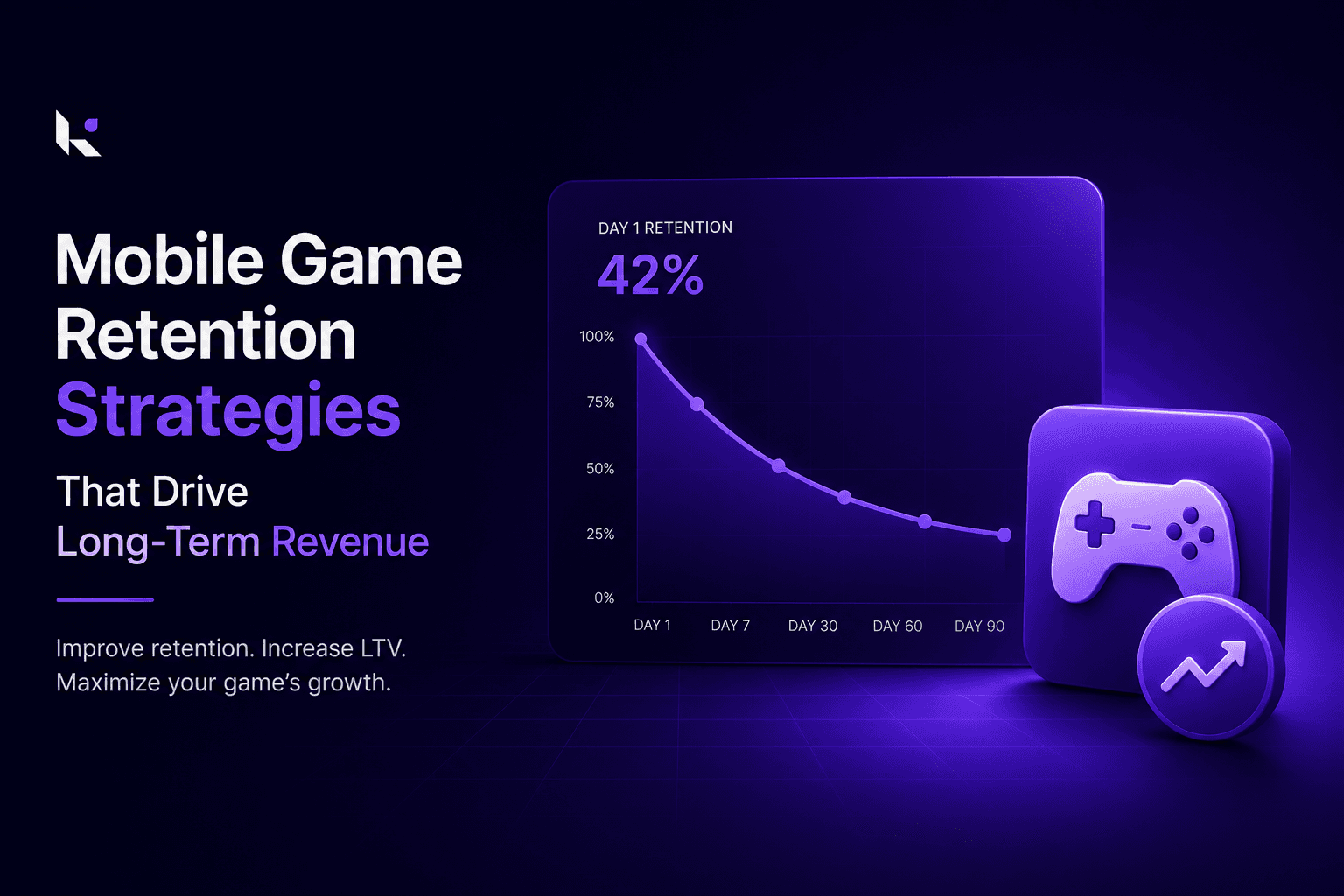
Mobile Game Retention Strategies That Drive Long-Term Revenue
Mobile game retention strategies are the tactical and product-focused methods game studios use to keep players engaged after install, reduce churn, and maximize lifetime value over weeks, months, and years.
For mobile game studios, retention is the foundation of sustainable growth. A player acquired today is worth nothing if they uninstall after three days. The real revenue comes from players who stay active, complete progression milestones, and generate repeat monetization signals that justify rising user acquisition costs.
This article examines proven retention approaches, the role of performance marketing in supporting them, and how studios integrate retention metrics into acquisition planning.
Why Mobile Game Retention Matters More Than First-Day Metrics
Installation is just the beginning. Day 1, Day 7, and Day 30 retention rates directly determine whether your acquisition economics work.
If your CPI is $2 but your D7 retention is 15%, you're burning cash. If that same $2 install has 40% D7 retention and strong D30 numbers, your LTV grows fast enough to justify scaling acquisition spend.
Retention also reduces your cost per active user. Keeping existing players engaged is cheaper than acquiring replacements. Studies show that focusing on retention reduces overall customer acquisition costs by shifting the retention-to-acquisition ratio in your favour.
Core Mobile Game Retention Mechanics
Progression Systems and Goals
Clear, achievable progression keeps players returning. Chapter-based systems, level gates, and milestone rewards create natural play sessions.
When a player reaches a goal (completing a quest, unlocking a new mechanic, advancing a tier), dopamine reinforces the behaviour. The next session starts with a new goal already visible, reducing friction to re-engagement.
Progression must scale smoothly. Early levels should be winnable within 5-15 minutes; mid-game levels require 20-40 minutes or more. Pacing matters.
Session Length and Cadence
Optimal session length varies by genre. Casual puzzle games work in 3-5 minute bursts. Strategy and RPGs accommodate 20-60 minute sessions.
Most successful games encourage daily logins through streaks, daily quests, or time-limited offers. A 7-day login streak that resets breaks habits; a rolling cumulative login reward (log in 3 of 7 days this week) is more forgiving and more sustainable.
Session frequency should feel rewarding, not punishing. Stamina systems that gate play can improve retention if the gates reset daily and the recharge time feels fair.
Social and Competitive Features
Guilds, clans, leaderboards, and co-op raids create external motivation. Players commit to teams, not just individual progress.
Real-time multiplayer and asynchronous PvP (where players battle replays of other players' teams) reduce churn because players feel accountable to their peers. Losing a guild war or letting teammates down carries social weight.
Chat, gifting, and shared progression also deepen retention. Players who have friends in-game churn at 40-50% lower rates than solo players.
Monetization and Retention: The Balance
Battle Pass and Season Systems
Seasonal content with a paid battle pass creates recurring revenue while supporting retention. A three-month season gives players a defined progression arc and a reason to log in regularly to earn rewards.
Free track rewards ensure free-to-play players progress too. Paid track exclusivity (cosmetics, currency, or convenience items) monetizes committed players without walling off core gameplay.
Seasons should launch with new content: map changes, balance patches, new heroes, or story chapters. Cosmetic updates alone are not enough to retain after the first week.
Limited-Time Events and FOMO
Time-limited events drive spikes in engagement. A seven-day raid event or a weekend tournament pulls dormant players back and reactivates churners.
Scarcity works, but must be fair. If rewards are exclusive to top-tier players, casual players feel punished. Tiered rewards (free, common, rare based on participation level) maximize participation.
Event frequency matters. Weekly events sustain momentum; monthly events alone create dry spells where retention drops.
Monetization Without Killing Retention
Aggressive monetization early (hard paywalls, aggressive ads, excessive stamina timers) damages D7 and D30 retention. Players uninstall before they spend money.
Successful games monetize committed players at Day 30+, not Day 1. Early monetization should be optional and soft: cosmetics, convenience, not power.
Rewarded video ads for in-game currency or stamina refills boost retention when they feel valuable, not forced. Placement matters; ads between sessions perform better than mid-gameplay interruptions.
User Acquisition and Retention Integration
Choosing the Right Traffic Source
Not all traffic sources produce equal retention. Organic search and app store featuring bring players actively seeking your game. These cohorts typically show 30-40% higher D7 retention than paid UA.
Paid user acquisition channels vary by audience intent. CPI campaigns reaching broad audiences may have lower inherent retention; rewarded install offers attract more engaged early adopters who will try your core loop.
This is where Klink Labs' performance marketing network helps studios optimize. With 350+ publishers and 10,000+ live offers across gaming verticals, studios can test cohort quality before scaling. CPI, CPA, and CPE campaign models let you target by intent: installs, verified actions (tutorial completion, first purchase), or engagement milestones.
Targeting for Retention Quality
Behavioural targeting improves cohort quality. Targeting players who have spent money on similar games historically shows 20-30% better D7 retention than broad demographic targeting.
Device and OS also matter. Some games perform better on flagship Android devices; others suit iOS where players tend to be older and spend more. Test, measure, and allocate budget accordingly.
Messaging also affects retention. If your creative emphasizes story and progression, you attract narrative-driven players who stay longer. If your creative emphasizes competition, you attract competitive players who stay if your PvP system is strong.
Retention Metrics and Measurement
Core Metrics to Track
Day 1, Day 7, Day 30 retention are the baseline. But also track:
Churn rate by cohort: Are day-one payers healthier? Do referral players churn faster?
Return rates: What percentage of churned players re-engage after two weeks?
Time to first purchase: Players who monetize faster tend to stay longer. Track the path to first purchase and optimise it.
Engagement per session: Longer session times correlate with better retention. Track average session length and daily active users.
Reporting and Iteration
Use mobile measurement platforms to track retention by user source, OS, device, and geography. Klink Labs provides real-time reporting on campaign performance; sync that with your game's analytics backend to see retention metrics by traffic source.
Weekly cohort analysis lets you catch retention drops early. A game that had 35% D7 retention last month but dropped to 28% this month needs urgent diagnosis: Was there a balance patch? A new competitor? A change in UA messaging?
Case Study: Real Retention Wins
Wirex, a fintech platform, partnered with Klink Labs for user acquisition and monetization. They achieved 207% growth in users and 68% growth in revenue through targeted CPA campaigns that attracted high-intent users.
While Wirex is fintech, not gaming, the principle applies: acquiring users who match your product's value proposition and monetization model produces better retention and LTV than raw volume.
For mobile games, this means testing your UA messaging and targeting to see which cohorts stay longest and spend most. Roxonn's presale campaign delivered 52.7% over-delivery on target through precision targeting and offer structure. Gaming studios can apply the same logic: test audience segments, track retention by source, and double down on sources that show the best D7 and D30 numbers.
Building a Retention Roadmap
Month 1-2: Core Loop and Day 1 Retention
Launch with a tight core gameplay loop. New players must understand the game's primary hook within the first five minutes.
Optimize tutorial completion rate. This is the first engagement metric; if 70% of players don't complete tutorial, your content and retention will suffer regardless of monetization strategy.
Add two weeks of content (story chapters, missions, events) to give players a clear progression path beyond the first session.
Month 3-4: Social and Seasonal Loops
Introduce multiplayer or social features. Guilds and leaderboards are lower-priority than core gameplay but essential by month three.
Launch your first season or battle pass. Pricing and rewards should be transparent; unclear value propositions kill conversion.
Month 5+: Monetization and Scaling
With D7 and D30 retention stable above 25-30%, introduce or expand monetization. Aggressive monetization before retention is solid will accelerate churn.
Begin scaling paid UA. Use platforms like Klink Labs that offer verified action tracking (CPA for tutorial completion, first purchase) to ensure cohorts meet retention benchmarks before spending heavy.
How Klink Labs Supports Game Studio Retention Strategy
Klink Labs connects 350+ publishers with 10,000+ live offers across gaming and adjacent verticals. For game studios, this means access to high-quality traffic sources that integrate with retention-focused acquisition models.
CPI campaigns reach volume; CPA campaigns (paying for tutorial completion, level milestones, or first purchase) let studios acquire players more likely to engage deeply. Real-time reporting shows retention by cohort, so you can optimise spend toward sources that produce the best D7 outcomes.
Campaigns launch in hours, not weeks. Testing new audience segments or messaging takes days, not months. This speed is essential when retention trends shift or new competitors emerge.
Get started with performance marketing for your game at klinklabs.com.
FAQ
Q: What is a good D7 retention rate for mobile games?
A: Retention benchmarks vary significantly by genre and target audience. Casual and hyper-casual games often see D7 rates between 20-40%; mid-core and hardcore games typically achieve 30-50%. The key is consistent week-over-week improvement and comparison against your own historical baseline, not against industry averages alone.
Q: How do I measure which traffic source produces the best retention?
A: Tag all traffic sources with a unique campaign identifier (using UTM parameters or a custom traffic source field in your game's analytics SDK). Then sync install data with your retention dashboard by cohort source. Track D1, D7, D30, and LTV by source. Over 2-3 weeks, patterns will emerge showing which sources attract users who stay longest.
Q: Should I prioritise retention or acquisition first?
A: Prioritise retention early. You cannot scale acquisition until your core gameplay loop is solid and D7 retention is stable above 20%. Once retention metrics are consistent, then scale acquisition spending. Acquiring players into a leaky game is wasteful; acquiring players into a sticky game compounds value.
Q: How often should I launch new content to maintain retention?
A: Minimum cadence is weekly new content or events. Monthly updates alone create dry spells where players churn. Weekly quests, bi-weekly balance patches, and monthly seasonal content provide a sustainable loop. Adjust frequency based on your team size and content pipeline.
Q: What role does user acquisition play in retention strategy?
A: Acquisition directly affects retention. Players acquired through channels aligned with your game's core value proposition (competitive players for PvP games, narrative-focused players for story games) show 20-30% better retention than broad audience acquisition. Use targeted CPI and CPA campaigns to test cohort quality before scaling spend.


High Quality Offers,
Real Payouts
Start Earning with Klink Now!









Share Article


